
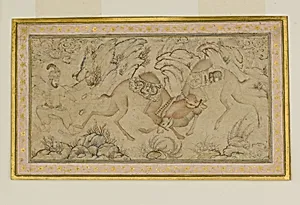
Two Camels Fighting
Unknown Artist
late 16th–early 17th century
Medium
Ink, watercolor, and gold on paper
Dimensions
Painting: H. 4 1/8 in. (10.5 cm) W. 7 7/8 in. (20 cm) Page: H. 5 1/2 in. (14 cm) W. 9 1/4 in. (23.5 cm) Mat: H. 14 1/4 in. (36.2 cm) W. 19 1/4 in. (48.9 cm)
Classification
Codices
Department
Islamic Art
Museum
Metropolitan Museum of Art, New York, NY
Credit
Bequest of George D. Pratt, 1935
Accession Number
45.174.20
Rights
Public Domain
Tags
Art Historical Context
This exquisite painting, *Two Camels Fighting*, a delicate leaf from an Islamic codex, likely part of a manuscript or album created in the late 16 to early 17th century. Rendered in ink, watercolor, and on paper, it measures just 4 1/8 by 7 7/8 inches, showcasing the miniaturist's mastery of fine detail in a compact format. Housed in the Metropolitan Museum of Art's of Islamic Art, it a dynamic scene of battling camels, with human figurespossibly handlers or spectators—adding tension and narrative depth. In the Islamic world, camels were vital for desert travel, trade, and warfare, and camel fights were a popular spectacle in regions like Persia, the Ottoman Empire, or North Africa, symbolizing strength and endurance. As a codex page, this work reflects the tradition of illuminated manuscripts, where illustrations brought stories, poems, or historical events to life. The use of gold highlights elevates the drama, lending a sense of opulence typical of Safavid or Mughal courtly art. The unknown artist's technique—precise ink lines for contours, subtle watercolor washes for form and motion, and shimmering gold for accents—exemplifies the refined aesthetics of Islamic painting. This bequest from George D. Pratt invites us to appreciate how everyday cultural rituals were transformed into timeless art, bridging the viewer to a vibrant historical moment.