
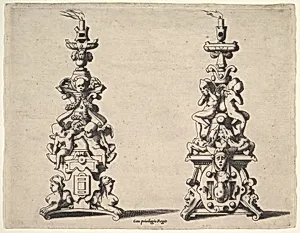
Two candlestick designs
ca. 1550–60
Medium
Engraving
Dimensions
plate: 5 1/2 x 7 1/16 in. (14 x 18 cm) sheet: 5 11/16 x 7 3/8 in. (14.5 x 18.7 cm)
Classification
Prints|Ornament & Architecture
Department
Drawings and Prints
Museum
Metropolitan Museum of Art, New York, NY
Credit
Bequest of Phyllis Massar, 2011
Accession Number
2012.136.25
Rights
Public Domain
Tags
Art Historical Context
In the mid-16th century, the height of the French Renaissance,avers like René Boyvin Pierre Milan created intricate designs that bridged art and craft. This engraving, titled *Two Candlestick Designs* (ca. 1550–60), showcases two elegant candelabra adorned with sphinxes—mythical creatures blending human and lion forms, symbols of enigma and guardianship drawn from classical antiquity. Produced as a print on a modest plate (5 1/2 x 7 1/16 in.), it exemplifies the ornamental prints flooding workshops across Europe, inspiring goldsmiths, silversmiths, and architects. Engraving's precision allowed for fine lines and rich tonal effects, making these designs highly reproducible and influential. Boyvin, a master of such motifs, often drew from Fontainebleau School grotesques, blending Italian Renaissance fantasy with Northern detail. Placed in the Metropolitan Museum of Art's Drawings and Prints department (Bequest of Phyllis Massar, 2011), this work highlights how prints democratized luxury design, fueling the era's passion for opulent furnishings. Today, it offers a window into Renaissance ingenuity, where everyday objects like candlesticks became canvases for mythological splendor. Visitors might imagine these sphinx-guarded torches illuminating royal chambers, a testament to art's power to elevate the functional.
About the Artist
René Boyvin|Pierre Milan · 1525–1580
French, Angers ca. 1525–1598 or 1625/6 Angers