
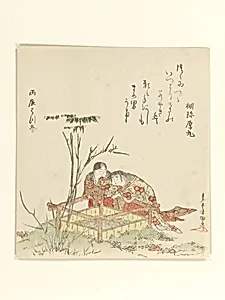
Two Children by a Well Curb
1796, year of the dragon
Medium
Woodblock print (surimono); ink and color on paper
Dimensions
Image: 7 3/8 x 6 3/4 in. (18.7 x 17.1 cm)
Classification
Prints
Culture & Period
Japan · Edo period (1615–1868)
Department
Asian Art
Museum
Metropolitan Museum of Art, New York, NY
Credit
Purchase, Marjorie H. Holden Gift, 2012
Accession Number
2012.248.21
Rights
Public Domain
Tags
Art Historical Context
Step into the vibrant world of Edo-period Japan (1615–1868) with Kubo Shunman'sTwo Children by a Wellurb*, a delicate woodblock print created in 1796, the Year of the Dragon. This surimono—a luxurious, privately commissioned print often made for celebrations like New Year's—captures two children poised at a well curb, evoking the simple joys of everyday life. Shunman (1777–1845), a master of ukiyo-e ("pictures of the floating world"), infused his works with poetic elegance, blending fine lines and subtle colors to portray intimate, fleeting moments. Printed with ink and color on paper, the artwork measures a compact 7 3/8 x 6 3/4 inches, ideal for personal albums or gifts. Surimono like this one stood out for their refined techniques, including crisp carving and vibrant pigments, contrasting mass-produced prints. The well, a symbol of community and sustenance in Japanese culture, frames the children's innocence, highlighting Shunman's skill in humanizing ordinary scenes amid Japan's urbanizing society. Now at the Metropolitan Museum of Art (Purchase, Marjorie H. Holden Gift, 2012), this piece offers a window into 18th-century Japan's artistic refinement, where zodiac years like the Dragon inspired bespoke treasures for the elite.
About the Artist
Kubo Shunman · 1757–1820
Japanese, 1757–1820