
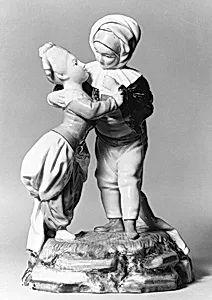
Two children in Turkish costume
Medium
Hard-paste porcelain
Dimensions
Height: 7 in. (17.8 cm)
Classification
Ceramics-Porcelain
Culture
German, Höchst
Department
European Sculpture and Decorative Arts
Museum
Metropolitan Museum of Art, New York, NY
Credit
Gift of R. Thornton Wilson, in memory of Florence Ellsworth Wilson, 1950
Accession Number
50.211.218
Rights
Public Domain
Tags
Art Historical Context
In the late 18th century, Höchst porcelain manufactory in Germany, near Frankfurt, produced some of Europe's finest hard-paste porcelain figures,ing the delicate translucency of Chinese exports. This charming pair, *Two Children in Turkish Costume*, created around 1770, exemplifies the work of master modeler Johann Peter Melchior. Standing just 7 inches tall, these hard-paste porcelain figures showcase the Rococo style's playful elegance, with meticulously painted details in vibrant enamels that capture flowing robes, fezzes, and intricate patterns inspired by Ottoman fashion. The "Turquerie" craze swept European courts during this era, blending exoticism with whimsy as aristocrats adorned their homes with faux-Turkish motifs. Höchst's figurines, like these children—likely a boy and girl—served as delightful tableaus for mantelpieces or cabinets, reflecting the era's fascination with the Orient amid Enlightenment curiosity. Melchior's expertise in naturalistic poses and expressive faces elevated these pieces from mere decorative objects to miniature sculptures. Today, this gift to the Metropolitan Museum of Art honors the Wilson family, preserving a snapshot of 18th-century German ceramic innovation and cultural fantasy. Visitors are drawn to their innocent charm, a testament to porcelain's versatility in storytelling.