
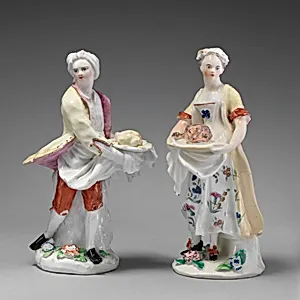
Two cooks
ca. 1760
Medium
Soft-paste porcelain
Dimensions
Overall (.695): 7 × 4 1/4 in. (17.8 × 10.8 cm); Overall (.696): 7 1/4 × 3 in. (18.4 × 7.6 cm)
Classification
Ceramics-Porcelain
Culture
British, Bow, London
Department
European Sculpture and Decorative Arts
Museum
Metropolitan Museum of Art, New York, NY
Credit
Gift of Irwin Untermyer, 1964
Accession Number
64.101.695, .696
Rights
Public Domain
Tags
Art Historical Context
Created around 1760 at London’s Bow Porcelain Factory, these two small figures capture the everyday world of Georgian Britain in delicate soft-paste porcelain. Standing just over seven inches tall, the male and female cooks hold the tools of their trade—ladles, spits, and baskets—bringing a touch of kitchen life into the drawing room. Bow was among the first English factories to produce porcelain commercially, and its wares offered middle- and upper-class households an affordable alternative to costly Chinese imports or German Meissen figures. Soft-paste porcelain, made with a mixture of clay, sand, and glass, could be modeled with lively detail yet remained slightly translucent and warm to the touch. At Bow, skilled modelers drew inspiration from popular prints and theater, translating contemporary occupations into charming, brightly enameled statuettes meant for mantelpieces or dining tables. These cooks, with their animated poses and period dress, reflect the era’s growing taste for narrative decoration that celebrated ordinary trades while showcasing new British manufacturing skill. Today the pair belongs to the Metropolitan Museum’s distinguished collection of European ceramics, a gift that preserves a vivid glimpse of eighteenth-century social life and the inventive spirit of early English porcelain.
About the Artist
Bow Porcelain Factory · 1747–1776
The Bow Porcelain Factory, established around 1747 in East London near Bow and relocated by 1749 to "New Canton" east of the River Lea, emerged as one of England's pioneering soft-paste porcelain manufacturers, rivaling the Chelsea factory. Founded by merchant Edward Heylyn and Irish painter Thomas Frye, who secured key patents in 1744 and 1748–49 for using Cherokee kaolin and bone ash, the factor...