
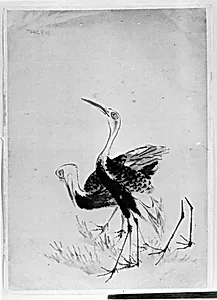
Two Cranes
19th century
Medium
Unmounted painting; ink and watercolor on paper
Dimensions
15 3/8 x 10 7/8 in. (39.1 x 27.6 cm)
Classification
Paintings
Culture & Period
Japan · Edo period (1615–1868)
Department
Asian Art
Museum
Metropolitan Museum of Art, New York, NY
Credit
Fletcher Fund, 1938
Accession Number
38.106.10
Rights
Public Domain
Tags
Art Historical Context
**Two Cranes**, created by an artist from the Hokusai School in 19th-century Japan during the Edo period (5–1868), the refined artistry of this influential workshop. Founded by the legendary Katsushika Hokusaifamous for woodblock prints like *The Great Wave*—the school extended his dynamic style into paintings. This unmounted work on paper, measuring 15⅜ × 10⅞ inches, uses delicate ink and watercolor to capture two elegant cranes, rendered with fluid brushstrokes that evoke Hokusai's mastery of form and movement. In Japanese culture, cranes symbolize longevity, fidelity, and good fortune, often depicted in pairs to represent marital harmony. During the Edo era, a time of peace and cultural flourishing under the Tokugawa shogunate, such motifs adorned homes and celebrations, blending Zen-inspired minimalism with vibrant expression. The unmounted format suggests it was originally part of an album or screen, allowing intimate appreciation of its subtle washes and precise lines—hallmarks of traditional *suibokuga* (ink painting) techniques. Acquired through the Fletcher Fund in 1938, this piece now graces the Metropolitan Museum of Art's Asian Art collection. It invites visitors to ponder the timeless grace of nature through the Hokusai School's lens, bridging everyday beauty with profound symbolism.