
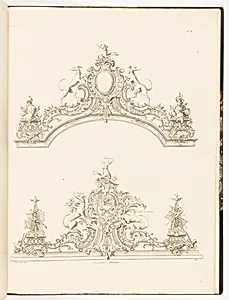
Two Designs for Ecclesiastical Ironwork
ca. 1764
Medium
Classification
Department
Smithsonian Collection
Museum
Smithsonian American Art Museum
Credit
Purchased for the Museum by the Advisory Council
Accession Number
1921-6-210-15
Rights
Public Domain
About this artwork
Research in Progress
Art Historical Context
Jean Lamour (1698–1771), a renowned French metalsmith, crafted this print titled *Two Designs for Ec Ironwork* around 1764. Active during the lavish Rococo era in 18th-century France, Lamour gained fame for his masterful wrought-iron creations, blending functionality with exuberant ornamentation. These designs likely served as blueprints for church railings, gates, or screens, reflecting the period's emphasis on grandeur in religious architecture amid the opulence of the Ancien Régime. As a print, this work exemplifies how architectural drawings were disseminated through engraving techniques, allowing artisans across Europe to replicate or adapt Lamour's intricate motifs—think scrolling foliage, floral motifs, and elegant curves typical of Rococo ironwork. Its ecclesiastical focus underscores the era's fusion of artistry and spirituality, where metalwork elevated sacred spaces with delicate yet durable beauty. Housed in the Smithsonian American Art Museum's collection, purchased by the Advisory Council, this piece highlights Lamour's enduring influence on decorative arts. Though research continues, it invites us to appreciate the precision and imagination behind France's gilded age of craftsmanship.