
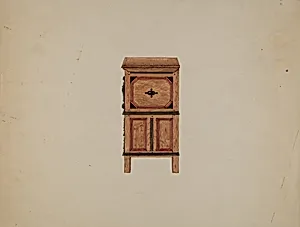
Two Drawer Sunflower Chest - side view
c. 1936
Medium
watercolor, colored pencil, pen and ink and graphite on paper
Dimensions
overall: 28.1 x 35.7 cm (11 1/16 x 14 1/16 in.) Original IAD Object: 48 1/2"long; 40 1/4"high; 21"wide
Classification
Index of American Design
Department
CG-W
Museum
National Gallery of Art, Washington, D.C.
Credit
Index of American Design
Accession Number
1943.8.4587
Rights
Public Domain
Art Historical Context
Behold the *Two Drawer Sunflower Chest - view*, a vibrant 1936 rendering by artist Martin Partyka, part of the esteemed Index of American Design. This detailed watercolor, colored pencil, pen and ink, and graphite drawing on paper (28.1 x 35.7 cm) captures side profile of a classic American folk furniture piece—measuring an impressive 48½ inches long, 40¼ inches high, and 21 inches in its original form. Sunflower motifs, a beloved emblem in early American decorative arts, likely adorn this two-drawer chest, evoking rural craftsmanship and natural abundance. Created during the Great Depression as part of the Federal Art Project under the Works Progress Administration (WPA), Partyka's work belongs to the Index of American Design (1935–1942). This ambitious initiative employed artists to document thousands of everyday objects, from quilts to furniture, preserving America's cultural heritage through precise, colorful illustrations. Partyka's piece highlights the ingenuity of vernacular design, blending functionality with floral whimsy, and underscores the era's push to celebrate national identity amid economic hardship. The mixed-media technique—layering translucent watercolors over meticulous ink lines and pencil shading—brings the chest's textures and curves to life, making the two-dimensional sheet feel almost tangible. Housed in the National Gallery of Art, this artwork invites us to appreciate how ordinary heirlooms embody our shared history. (198 words)
About the Artist
Martin Partyka · 1855–present
Martin Partyka is an artist whose biographical record is sparse. No confirmed dates of birth or death have been established, and his nationality and geographic context remain unverified in the available literature. Despite this uncertainty, Partyka's surviving works — held in museum collections — indicate an active artistic practice. The number and range of pieces attributed to him suggest a work...