
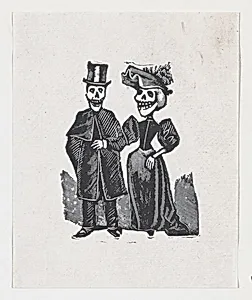
Two elegantly dressed skeletons walking, from a broadside entitled, 'El Gran Panteon Amoroso,' published by Antonio Vanegas Arroyo.
ca. 1880–1910
Medium
Etching on zinc
Dimensions
Sheet: 3 1/4 × 2 5/8 in. (8.3 × 6.7 cm)
Classification
Prints
Department
Drawings and Prints
Museum
Metropolitan Museum of Art, New York, NY
Credit
Gift of Jean Charlot, 1930
Accession Number
30.82.46
Rights
Public Domain
Tags
Art Historical Context
In the vibrant world of Mexican printmaking, José Guadalupe Posada (1852–1913) created this striking etching around 1880–1910 as part of the broadside *El Gran Panteón Amoroso*, published by Antonio Vanegas Arroyo Posada, a pioneering artist of the calavera (skeleton) genre, used his bold, satirical style to mock societal vanities during Mexico's Porfiriato era time of stark class divides under dictator Porfirio Díaz. affordable zinc etchings, distributed as cheap news sheets, brought art to the masses, blending humor with mordant social commentary. The diminutive image (just 3¼ × 2⅝ inches) depicts two skeletons strolling arm-in-arm, clad in top hats, bow ties, and tailcoats—an elegant parody of the bourgeoisie. Their poised gait underscores Posada's signature theme: death levels all, stripping away pretensions of wealth and fashion. Etching on zinc allowed for crisp, high-contrast lines and mass production, making it ideal for ephemera that captured the public's imagination. Housed in the Metropolitan Museum of Art's Drawings and Prints department (gift of Jean Charlot, 1930), this print exemplifies Posada's influence on Mexican iconography, foreshadowing Day of the Dead traditions and inspiring later artists like Diego Rivera. It's a witty reminder that even the dandiest souls dance with mortality.
About the Artist
José Guadalupe Posada · 1852–1913
José Guadalupe Posada (1852-1913) was a Mexican printmaker and engraver who revolutionized popular art and created some of the most iconic images in Mexican culture. Working primarily with publisher Antonio Vanegas Arroyo, he produced over 20,000 images during his career—inexpensive broadsheets sold for a penny on colored paper that made his art accessible to even the poorest workers. He transform...