
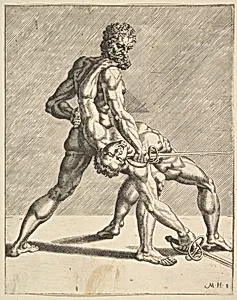
Two Fencers, from Fencers, plate 8
Medium
Etching and engraving.
Dimensions
Sheet: 9 13/16 x 7 11/16 in. (24.9 x 19.6 cm)
Classification
Prints
Department
Drawings and Prints
Museum
Metropolitan Museum of Art, New York, NY
Credit
The Elisha Whittelsey Collection, The Elisha Whittelsey Fund, 1949
Accession Number
49.95.2331(6)
Rights
Public Domain
Tags
About this artwork
This prints titled "Two Fencers, from Fencers, plate 8" by Maarten van Heemskerck|Cornelis Bos|Dirck Volckertsz Coornhert dates to 1552. Executed in etching and engraving., this work exemplifies the craftsmanship associated with Drawings and Prints. The piece demonstrates the technical skill and artistic vision characteristic of its period. The work's presence in a major museum collection attests to its significance in the broader narrative of art history. As part of institutional holdings, it s...
Art Historical Context
"Two Fencers, fromencers, plate 8" (1552) is a dynamic print from a collaborative series by Dutch Renaissance artist Maarten van Heemskck, with engravings by Cornelis and Dirck Volcksz Coornhert. Measuring just under 10 by 8 inches, this etching and engraving captures two male nudes engaged in fencing, swords poised in mid-action. Heemskerck's reflect the Mannerist interest in anatomical precision and twisting poses, inspired by classical antiquity and Italian influences from his Roman travels. The medium—etching combined with engraving—highlights mid-16th-century innovations in Northern European printmaking, allowing for intricate lines and tonal depth that reproduced complex figures affordably. As plate 8 in the "Fencers" series, it showcases martial prowess through idealized nude forms, blending athletic study with artistic virtuosity. Housed in the Metropolitan Museum of Art's Drawings and Prints department since 1949, this work offers a window into Renaissance fascination with the body in motion, chivalric sports, and the rise of prints as educational tools. Visitors will appreciate its technical finesse and lively energy, a testament to collaborative genius in Haarlem's golden age of art.