
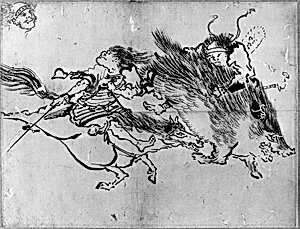
Two Figures
19th century
Medium
Matted painting; ink on paper (wash drawing?)
Dimensions
10 3/8 x 14 in. (26.4 x 35.6 cm)
Classification
Paintings
Culture & Period
Japan · Edo period (1615–1868)
Department
Asian Art
Museum
Metropolitan Museum of Art, New York, NY
Credit
Fletcher Fund, 1937
Accession Number
37.119.3
Rights
Public Domain
Tags
Art Historical Context
Katsushika Hokusai’s *Two Figures* offers a glimpse into the artistic world of Japan’s Edo period (1615–1868), a time of relative peace when urban culture flourished and artists like Hokusai explored both everyday life and dynamic subjects. Created in the 19th century, this intimate ink-on-paper wash drawing reflects Hokusai’s lifelong experimentation with spontaneous brushwork and expressive line, skills he honed across paintings, sketches, and his renowned woodblock prints. The work’s modest scale—roughly 10 by 14 inches—highlights the artist’s ability to suggest movement and character with minimal strokes. Tags indicate the presence of men, horses, and boars, hinting at a lively rural or narrative scene that may evoke themes of travel, labor, or nature’s vitality common in Japanese art of the era. Acquired by the Metropolitan Museum through the Fletcher Fund in 1937, the painting exemplifies Hokusai’s enduring influence on both Japanese and Western perceptions of ukiyo-e aesthetics.
About the Artist
Katsushika Hokusai · 1760–1849
Katsushika Hokusai (1760-1849) stands as one of history's most influential artists, a Japanese master who revolutionized the ukiyo-e woodblock print tradition and profoundly shaped Western art. Born in the Katsushika district of Edo (modern-day Tokyo) to an artisan family, Hokusai lived through nearly nine decades of extraordinary creative evolution, adopting over thirty different artistic names t...