
Two Flatfish and Plum
ca. 1795 - ca. 1800
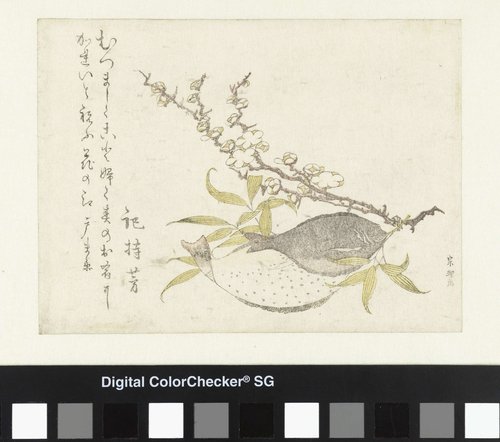
Medium
color woodcut
Dimensions
124; 167
Rights
Public Domain
About this artwork
Bruikleen van de Koninklijke Vereniging van Vrienden der Aziatische Kunst (legaat Westendorp-Osieck, 1968)
Art Historical Context
Katsushika Hokus's *Two Flatfish and Plum*, around 1795–1800, exemplifies the master's early mastery of ukiyo-e, the Japanese woodblock print tradition capturing the fleeting beauty of the "floating world." This intimate color woodcut, measuring just 124 mm high by 167 mm wide, likely belongs to the surimono genre—luxury prints often commissioned for special occasions like New Year's greetings. Hokusai, who would later produce iconic works like *The Great Wave off Kawa*, here turns his keen eye to a simple still life: two flatfish and ripening plums, rendered with vibrant hues and precise lines that evoke seasonal abundance and nature's quiet poetry. The woodblock technique shines in this piece, with separate blocks carved for each color layer, allowing Hokusai to achieve subtle gradients and textures on washi paper. During Japan's Edo period (1603–1868), such prints were affordable art for urban dwellers, blending artistry with everyday motifs. Flatfish and plums carry cultural resonance—plum blossoms symbolizing resilience in winter, while fish nod to coastal bounty—reflecting Zen-inspired appreciation for impermanence. Today, this gem is on loan from the Koninklijke Vereniging van Vrienden der Aziatische Kunst (Westendorp-Osieck bequest, 1968), offering visitors a window into Hokusai's versatile genius before his fame peaked. Its diminutive scale invites close inspection, revealing the enduring allure of ukiyo-e's technical brilliance and harmonious simplicity.
About the Artist
Katsushika Hokusai · 1760–1849
Katsushika Hokusai (1760-1849) stands as one of history's most influential artists, a Japanese master who revolutionized the ukiyo-e woodblock print tradition and profoundly shaped Western art. Born in the Katsushika district of Edo (modern-day Tokyo) to an artisan family, Hokusai lived through nearly nine decades of extraordinary creative evolution, adopting over thirty different artistic names t...