
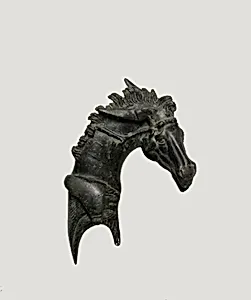
Two fulcra (headrest) attachments in the form of mule's heads
Unknown Artist
ca. late 3rd–1st century BCE
Medium
Bronze
Dimensions
H. 3 1/2 in. (8.9 cm)
Classification
Bronzes
Culture & Period
Greek · Hellenistic
Department
Greek and Roman Art
Museum
Metropolitan Museum of Art, New York, NY
Credit
Rogers Fund, 1913
Accession Number
13.227.9, .10
Rights
Public Domain
Tags
Art Historical Context
These charming bronze attachments, shaped as mule heads, served as fulcra—curved headrest supports—for ancient Greek couches known as *klinai*. Dating to the Hellenistic period (ca. late 3rd–1st century BCE), they reflect the era's blend of everyday utility and artistic flair. Hellenistic art, flourishing after Alexander the Great's conquests, emphasized naturalism and emotional expressiveness, moving beyond the idealized forms of Classical Greece. Mules, sturdy pack animals essential for trade and travel across the expanding Hellenistic world, were cleverly immortalized here, perhaps evoking the vibrancy of daily life or mythological tales. Crafted in bronze—a prized medium for its durability and ability to capture fine details—these small sculptures (just 3½ inches high) showcase skilled lost-wax casting techniques. The sculptors rendered the mules' alert ears, textured manes, and expressive faces with remarkable realism, highlighting anatomical precision typical of Hellenistic bronzes. Such attachments adorned elite furniture in symposia or homes, signaling wealth and cultural sophistication. Today, these mule heads at the Metropolitan Museum of Art offer a glimpse into Hellenistic domestic luxury, reminding us how ancient Greeks infused even functional objects with artistry. Imagine reclining on a couch like this during a lively banquet—history comes alive!