
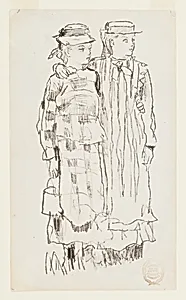
Two Girls
Medium
figures
Classification
figures
Department
Smithsonian Collection
Museum
Smithsonian American Art Museum
Credit
Gift of Charles Savage Homer, Jr.
Accession Number
1912-12-71
Rights
Public Domain
About this artwork
Research in Progress
Art Historical Context
**Two Girls** (1879) by Winslow Homer captures the essence late 19th-century American through its simple yet evocative portrayal of two young figures. Painted by the renowned American realist Winslow Homer (1836–1910), this work reflects his shift toward intimate scenes of everyday people after the Civil War. Homer, who began as a magazine illustrator, evolved into a master of depicting rural and coastal subjects with unflinching honesty and emotional depth. Homer's realist style emphasizes natural light, candid poses, and the dignity of ordinary moments, often highlighting children as symbols of innocence and resilience. Though details of the medium are noted simply as "figures," the classification underscores Homer's skill in rendering human forms with psychological insight—qualities that set him apart in the American art scene. Created during a prolific period when Homer traveled extensively in the U.S. and abroad, *Two Girls* exemplifies his ability to distill universal themes from the mundane. Now part of the Smithsonian American Art Museum's collection, gifted by Homer's brother Charles Savage Homer, Jr., this piece invites reflection on youth amid a changing America. Research continues to uncover more about its creation, but it stands as a testament to Homer's enduring legacy in celebrating the American spirit. (198 words)