
Two-handled Cup
ca.1790
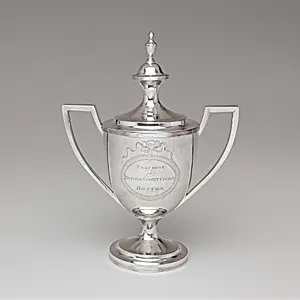
Medium
Silver
Dimensions
Overall: 11 5/8 x 8 13/16 in. (29.5 x 22.4 cm); 23 oz. 5 dwt. (722.5 g) Cup without cover: H. 8 in. (20.3 cm); 17 oz. 9 dwt. (542.5 g) Lip: Diam. 5 in. (12.7 cm) Foot: Diam. 4 3/16 in. (10.6 cm) Cover: 4 9/16 x 4 13/16 in. (11.6 x 12.2 cm): 5 oz. 16 dwt. (180 g)
Classification
Cup
Culture
American
Department
The American Wing
Museum
Metropolitan Museum of Art, New York, NY
Credit
Bequest of Alphonso T. Clearwater, 1933
Accession Number
33.120.233
Rights
Public Domain
Art Historical Context
Crafted around 1790 by Boston silversmith Joseph Loring, this elegant two-handled silver cup exemplifies the refined artistry of early Federal America. Standing 11⅝ inches tall with its domed cover, the piece weighs a substantial 23 ounces, underscoring the opulence of high-end silversmithing. Loring, active in post-Revolutionary Boston, was renowned for his precise chasing and engraving techniques, blending neoclassical motifs with practical functionality—perfect for toasts, ceremonies, or society memberships. In the context of the young United States, such cups symbolized prosperity and civic pride. Silver objects like this were status symbols for the emerging merchant class, often gifted to honor achievements or commemorate events. The two-handled form, reminiscent of ancient Greek kylixes adapted through English influences, highlights the transatlantic exchange of design during the Federal period. Its intricate proportions— from the 5-inch lip diameter to the sturdy 4¼-inch foot—ensure both balance and grandeur. Housed in The Metropolitan Museum of Art's American Wing, this cup was bequeathed by Alphonso T. Clearwater in 1933, preserving a tangible link to America's silversmithing golden age. Visitors will appreciate its gleaming patina, a testament to enduring craftsmanship.