
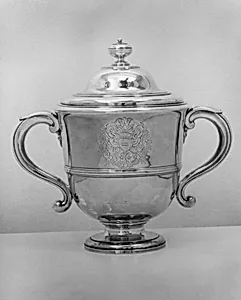
Two-handled cup with cover
1709–10
Medium
Silver
Dimensions
Overall (with cover and handles): 8 7/8 × 9 1/4 in. (22.5 × 23.5 cm)
Classification
Metalwork-Silver
Culture
British, London
Department
European Sculpture and Decorative Arts
Museum
Metropolitan Museum of Art, New York, NY
Credit
Gift of Irwin Untermyer, 1958
Accession Number
58.47.3a, b
Rights
Public Domain
Tags
Art Historical Context
Crafted by the esteemed London silversmith Simonin I between 1709 and 1710, this two-handled silver cup with cover exemplifies the refined elegance of early 18th-century British metalwork. Standing at nearly 9 inches tall and wide, its graceful proportions and functional design—with sturdy handles for passing and a fitted cover—suggest it served as a ceremonial "standing cup" or loving cup, ideal for toasts at banquets or family gatherings. Pantin, active during Queen Anne's reign (1702–1714), was renowned for his meticulous craftsmanship, contributing to London's thriving silver trade fueled by Huguenot émigrés and aristocratic demand. The medium of silver holds profound cultural weight in Georgian Britain, symbolizing wealth, status, and hospitality. Hallmarked for London, this piece likely bears a coat of arms, personalizing it for a prominent family and underscoring its role in heraldic traditions. Techniques such as chasing, embossing, and seaming would have transformed raw silver into a gleaming heirloom, blending Baroque exuberance with emerging restraint—hallmarks of the Queen Anne style. Today, housed in The Metropolitan Museum of Art thanks to a 1958 gift from Irwin Untermyer, it invites us to imagine candlelit halls where such treasures passed from hand to hand, preserving stories of refinement and revelry across centuries.