
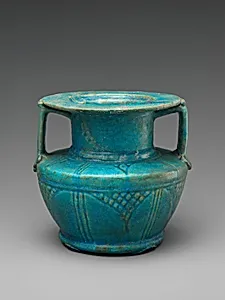
Two-Handled Jar
Unknown Artist
ca. 1st–2nd century A.D
Medium
Faience
Dimensions
H. 18.4 × Rim ext. 17.4 × W. 20.2 cm (7 1/4 × 6 7/8 × 7 15/16 in.)
Period
Roman Period
Department
Egyptian Art
Museum
Metropolitan Museum of Art, New York, NY
Credit
Bequest of Nanette B. Kelekian, 2020
Accession Number
2021.41.171
Rights
Public Domain
Art Historical Context
This elegant two-handled jar, crafted from faience around the 1st–2nd century A.D. during Egypt's Roman Period, exemplifies enduring artistry of ancient Egyptian workshops. Standing about 7 inches tall with a wide rim and sturdy handles, it measures 18.4 cm high, 17.4 cm rim diameter, and 202 cm wide—perfectly sized for practical use in a household or temple setting. Faience a signature Egyptian medium made from ground quartz paste coated in vibrant turquoise or blue glaze, mimicked the luster of precious lapis lazuli or turquoise, making luxury accessible to a broader audience. Produced under Roman rule, when Egypt was a vital province supplying grain and goods to the empire, this jar reflects the fusion of local traditions with Mediterranean influences. Faience vessels like this were fired at low temperatures, allowing intricate molding and glazing techniques that produced a smooth, glassy surface resistant to liquids. They often held oils, perfumes, or cosmetics, blending utility with aesthetic appeal in daily life or rituals. Now at the Metropolitan Museum of Art through the bequest of Nanette B. Kelekian in 2020, this anonymous masterpiece highlights the resilience of Egyptian craftsmanship amid cultural shifts, inviting us to ponder the hands that shaped it over 1,800 years ago.