
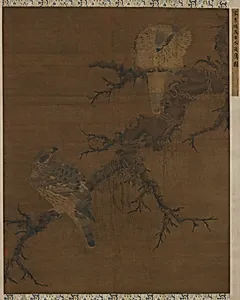
Two Hawks on a Barren Bough
Classification
Painting
Department
Smithsonian Collection
Museum
Smithsonian American Art Museum
Credit
Gift of Charles Lang Freer
Accession Number
F1917.337
Rights
Public Domain
Tags
About this artwork
Zhe School
Art Historical Context
**Two Hawks on a Barren Bough** This striking painting, dated to the 16th century during China's Ming dynasty (13681644), belongs to the Zhe School, a guild of artists from Zhejiang province renowned for their vibrant bird-and-flower compositions. attributed to the Song-era painter Li Demao (late 12th–early 13th century), it reflects the Ming taste for emulating earlier masters while infusing works with bold colors and intricate details. The Zhe style bridged classical Song traditions with a more decorative flair, often celebrating nature's harmony through perched birds on sparse branches. Depicting two majestic hawks—sometimes interpreted as eagles—poised alertly on a barren bough, the artwork embodies Confucian ideals of vigilance and strength. Hawks symbolized martial prowess and nobility in Chinese culture, making this a potent emblem of imperial virtue. Though the medium remains unidentified, such paintings typically employed ink and mineral pigments on silk or paper, showcasing masterful brushwork that captures the birds' fierce gaze and the branch's twisted elegance against an implied vast sky. A cherished gift from collector Charles Lang Freer to the Smithsonian American Art Museum, this piece highlights Freer's passion for Asian art and enriches our understanding of Ming decorative painting's enduring appeal. Visitors will appreciate its poised tension, inviting reflection on nature's quiet power.