
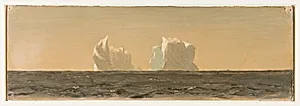
Two Icebergs, Canada
June–July 1859
Medium
seascapes
Classification
seascapes
Department
Smithsonian Collection
Museum
Smithsonian American Art Museum
Credit
Gift of Louis P. Church
Accession Number
1917-4-290-a
Rights
Public Domain
About this artwork
Research in Progress
Art Historical Context
**Two Icebergs, Canada** Frederic Edwin Church, leading figure of the Hudson River School captured the sublime power of nature in this 1859 oil seascape. Painted during his summer expedition to Labrador and the Canadian Arctic in June–July, the work depicts a pair of majestic icebergs adrift in frigid waters, reflecting Church's fascination with dramatic natural phenomena. As an American artist (1826–1900), Church was renowned for his meticulous studies of light, atmosphere, and vast, blending Romanticism with precise observation to evoke awe and the divine in the American wilderness. Church's technique shines in his luminous rendering of ice and sea, achieved through layered glazes and empirical sketches made on-site. This piece exemplifies the Hudson River School's emphasis on the Hudson River Valley's luminist style—characterized by glowing effects and transcendental themes—while venturing into polar exploration, a timely subject amid 19th-century Arctic fascination and scientific voyages. Now in the Smithsonian American Art Museum's Smithsonian Collection, *Two Icebergs, Canada* was generously gifted by Church's son, Louis P. Church. It invites visitors to ponder humanity's place amid nature's grandeur, a timeless message from an era of expanding frontiers. (198 words)