
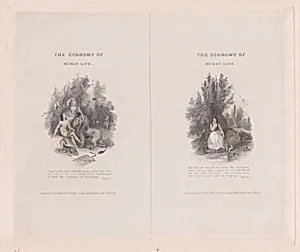
Two illustrations for "The Economy of Human Life"
Medium
Engraving on chine collé, proof
Dimensions
Plate (two images): 7 × 8 9/16 in. (17.8 × 21.7 cm) Sheet: 8 5/8 × 11 7/8 in. (21.9 × 30.2 cm)
Classification
Prints
Department
Drawings and Prints
Museum
Metropolitan Museum of Art, New York, NY
Credit
The Elisha Whittelsey Collection, The Elisha Whittelsey Fund, 1966
Accession Number
66.542.37(16)
Rights
Public Domain
Tags
Art Historical Context
Step into the world of 19th-century literature with *Two Illustrations for "The Economy of Life"*, a delicate proof engraving created in 1834. Attributed to Robert Dods, John van Voorst, and Howard, this print features two vivid scenes populated by lions, dogs, men,, and deer—likelyorical vignettes from Dodsley's 1751 guide to ethical living, reimagined for a new edition. Housed in the Metropolitan Museum of Art's Drawings and Prints department, it measures a modest plate size of 7 × 8 9/16 inches, inviting close inspection of its intricate details. Crafted as an engraving on chine collé—a refined technique where thin Chinese paper is adhered to a sturdy support for superior ink retention and subtle tonal gradations—this proof represents the meticulous trial stage of printmaking. Common in the Romantic era, such proofs allowed artists like Howard, a skilled engraver, to refine lines before mass production, capturing dynamic interactions between humans and beasts that symbolize virtue, temptation, or nature's harmony. As part of The Elisha Whittelsey Collection, this work highlights the era's blend of literature and visual art, bridging Enlightenment morals with Victorian sensibilities. A charming glimpse into book illustration's evolution, it reminds us how prints once brought profound lessons to life on the page.
About the Artist
Robert Dodsley|John van Voorst|Frank Howard (British|British) · 1703 |1805 –1764 |1866
British, 1703–1764|British, London 1805–1866 Liverpool