
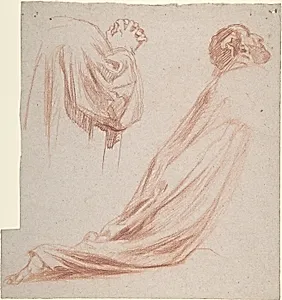
Two Kneeling Figures
1830–71
Medium
Red chalk on light gray paper
Dimensions
Overall: 9 7/16 x 8 3/8in. (23.9 x 21.2cm)
Classification
Drawings
Department
Drawings and Prints
Museum
Metropolitan Museum of Art, New York, NY
Credit
Van Day Truex Fund, 1991
Accession Number
1991.96.6
Rights
Public Domain
Tags
Art Historical Context
**Two Kneeling Figures** is a delicate drawing by Alexandre Laemlein, sometime between 1830 and1871. Rendered in red chalk—also known as sanguine—on light gray paper, this intimate study measures just 9 7/16 x 8 3/8 inches, inviting close contemplation in the Metropolitan Museum of Art's Drawings and Prints collection. Acquired through the Van Day Truex in 1991, it exemplifies 19th-century European draftsmanship, a period when artists honed their skills through meticulous figure studies. The composition features two male figures kneeling in contemplative poses, their forms softly modeled with the warm, earthy tones of red chalk. This medium, prized since the Renaissance but thriving in the Romantic era, excels at capturing the subtle play of light and shadow on human anatomy, lending a lifelike immediacy to sketches like this. Laemlein's precise yet fluid lines suggest a focus on gesture and proportion, common in preparatory works for paintings or sculptures. Though little is documented about Laemlein, this drawing reflects the era's fascination with the male nude as a symbol of idealized strength and vulnerability. Visitors will appreciate its tactile quality—hold it up to the light, and the chalk's glow evokes the artist's hand at work, bridging 19th-century studio practice with our modern gaze.