
Two Medallions
Unknown Artist
ca. 1420
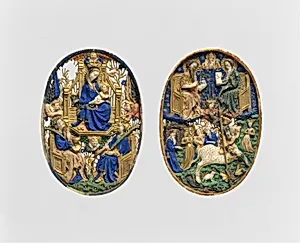
Medium
Ivory, polychromy & gilding, (later mount: gilt silver and glass)
Dimensions
Overall (Open with Mount): 3 5/8 x 4 1/8 x 9/16 in. (9.2 x 10.5 x 1.4 cm) Overall (Closed with Mount): 3 5/8 x 2 1/8 x 13/16 in. (9.2 x 5.4 x 2.1 cm) ivory insets: 2 5/16 x 1 5/8 in. (5.8 x 4.1 cm)
Classification
Ivories
Culture
French
Department
Medieval Art
Museum
Metropolitan Museum of Art, New York, NY
Credit
Gift of J. Pierpont Morgan, 1917
Accession Number
17.190.877a-c
Rights
Public Domain
Tags
Art Historical Context
Nestled in the Metropolitan Museum of Art's Medieval Art collection, *Two Medallions* (ca. 1420) is a delicate French ivory diptych, gifted by J. Pierpont Morgan in 1917. Crafted from ivory with vibrant polychromy and gilding, it features two small insets (each about 2¼ x 1½ inches) housed in a later gilt-silver mount with glass. This portable format—opening to 3⅝ x 4⅛ inches and closing compactly—suggests it was designed for private devotion, a common luxury item from late Gothic workshops, likely in Paris. The medallions depict sacred figures central to Christian iconography: the Madonna and Child, Saint John the Baptist, Saint John the Evangelist, God the Father, and horses, rendered in intricate relief. Polychromy adds lifelike color to the carved ivory, while gilding highlights divine radiance, enhancing its spiritual allure. Such techniques elevated ivories as treasured objects for nobility and clergy, blending artistry with piety during the waning Middle Ages. This anonymous masterpiece exemplifies the refined elegance of French Gothic ivories, where miniature scale demanded masterful precision. Visitors can appreciate how it bridged personal faith and opulent craftsmanship, offering a window into 15th-century devotion.