
Two Men Contemplating the Moon
ca. 1825–30
Medium
Oil on canvas
Dimensions
13 3/4 x 17 1/4 in. (34.9 x 43.8 cm)
Classification
Paintings
Department
European Paintings
Museum
Metropolitan Museum of Art, New York, NY
Credit
Wrightsman Fund, 2000
Accession Number
2000.51
Rights
Public Domain
Tags
About this artwork
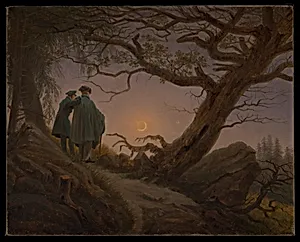
Caspar David Friedrich's 'Two Men Contemplating the Moon' (ca. 1825-30) stands as a defining masterpiece of German Romanticism, the third version of a composition Friedrich first created in 1819. The painting depicts two figures seen from behind—a compositional device known as Rückenfigur—inviting viewers to join their contemplative communion with nature. One figure has often been identified as Friedrich himself, while the other is believed to be his disciple August Heinrich (1794-1822), though ...
Art Historical Context
Caspar David Friedrich's * Men Contemplating the* (ca. 1825–30), an oil on canvas masterpiece from the Metropolitan Museum of Art, exemplifies Romanticism's reverence for nature's sublime power. This is the third version of a composition first painted in 1819, showcasing Friedrich's signature Rückenfigur technique—figures viewed from behind that draw viewers into their quiet awe. Here, two men stand silhouetted against a twilight landscape, gazing at a glowing crescent moon rising over jagged rocks and a gnarled, evoking a natural cathedral that blends the earthly and divine. One figure is often seen as Friedrich himself, accompanied by his disciple August Heinrich, who died in 1822—making this later rendition a poignant meditation on loss, memory, and transcendence. The moon, a Romantic obsession, symbolized the bridge between scientific curiosity and spiritual longing, countering the era's rationalism with emotional depth. Friedrich's layered symbolism invited 19th-century audiences to seek renewal amid industrialization, transforming a modest 13¾ × 17¼-inch canvas into a portal for personal reflection. (198 words)
About the Artist
Caspar David Friedrich · 1774–1840
Leading artist of the German Romantic movement. He was particularly known for his symbolic and atmospheric treatment of landscape.