
Two Men from "The Hermae"
dated 1536
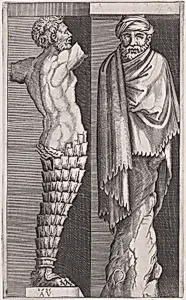
Medium
Engraving
Dimensions
8 1/16 x 4 15/16 in. (20.4 x 12.5 cm)
Classification
Prints
Department
Drawings and Prints
Museum
Metropolitan Museum of Art, New York, NY
Credit
Harris Brisbane Dick Fund, 1926
Accession Number
26.50.1(62)
Rights
Public Domain
Art Historical Context
In the heart of the High Renaissance, Agostino Venez (Agostino dei Musi a masterful Italian engraver active in Rome and Venice, created *Two Men from "Theae"* in 1536. This intimate engraving, measuring just 8 1/16 x 4 15/16 inches, captures classical herm figures—pillar-like sculptures topped with male heads, evoking ancient Greek boundary markers sacred to Hermes. Veneziano, known for his precise reproductive prints after designs by Raphael and other masters, drew on the era's fascination with Greco-Roman antiquity, revived through archaeological discoveries and humanist scholarship. Engraving, Veneziano's chosen medium, was revolutionary for disseminating intricate designs to a wide audience beyond original sculptures or paintings. Using a burin to incise fine lines into a copper plate, he achieved remarkable depth, texture, and tonal subtlety, making classical motifs accessible to collectors and scholars. This print exemplifies the technique's power to preserve and popularize antiquity during a time when artists like Michelangelo were reinterpreting ancient forms. Today, housed in the Metropolitan Museum of Art's Drawings and Prints department (acquired via the Harris Brisbane Dick Fund in 1926), it invites visitors to ponder the Renaissance bridge between past and present—where mythic guardians become timeless emblems of human ingenuity.