
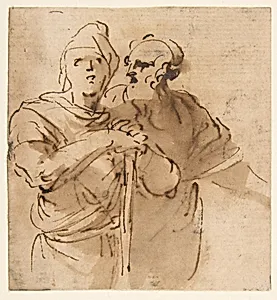
Two Men Seen Three- Quarter Length
1615–73
Medium
Pen and brown ink, brown wash
Dimensions
3-1/2 x 3-1/4 in. (8.8 x 8.2 cm)
Classification
Drawings
Department
Drawings and Prints
Museum
Metropolitan Museum of Art, New York, NY
Credit
Rogers Fund, 1970
Accession Number
1970.101.17
Rights
Public Domain
Tags
Art Historical Context
In the bustling world of 17th-century Italian Baroque art, Salvator Rosa (1615–1673) stands out for his dramatic flair and rebellious spirit. This intimate drawing, *Two Men Seen Three-Quarter Length*, captures two figures in a three-quarter view—a classic pose that lends depth and dynamism. Executed in pen and brown ink with brown wash over a small sheet measuring just 3-1/2 x 3-1/4 inches, it exemplifies Rosa's mastery of rapid, expressive sketches, likely created as a study for larger paintings or as an independent work prized by collectors. Rosa, a versatile artist from Naples who later thrived in Florence and Rome, infused his drawings with the rugged energy of his landscapes and battle scenes, foreshadowing Romanticism. The brown wash technique adds subtle tonal modeling, bringing the men's forms to life with economical strokes—highlighting his innovative approach to light and shadow amid the era's grand Mannerist traditions. Acquired through the Rogers Fund in 1970, this gem from The Metropolitan Museum of Art's Drawings and Prints department offers a glimpse into Rosa's private creative process. Though modest in scale, the work reveals the cultural fascination with male portraiture in Baroque Italy, where such studies bridged portraiture and narrative art, inviting viewers to ponder the men's identities and stories. A testament to Rosa's enduring legacy, it reminds us how small sketches can pack profound artistic punch.
About the Artist
Salvator Rosa · 1615–1673
Salvator Rosa was born in 1615 in Arenella, on the outskirts of Naples, into a world of artistic ambition and turbulent talent. His early training came through his maternal uncle, the painter Paolo Greco, and his brother-in-law Francesco Fracanzano, himself a pupil of the great Spanish-born Neapolitan master Jusepe de Ribera. Rosa showed a fierce independence from the start, resisting his father's...