
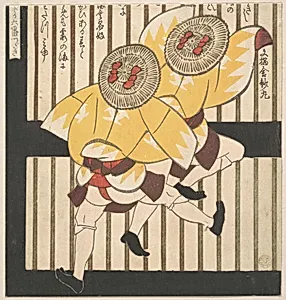
Two Men Wearing Yellow Coats and Straw Hats with Red Bows
1840
Medium
Woodblock print (surimono); ink and color on paper
Dimensions
7 1/8 x 6 13/16 in. (18.1 x 17.3 cm)
Classification
Prints
Culture & Period
Japan · Edo period (1615–1868)
Department
Asian Art
Museum
Metropolitan Museum of Art, New York, NY
Credit
Rogers Fund, 1921
Accession Number
JP1250
Rights
Public Domain
Tags
Art Historical Context
In the vibrant world of Edo-period Japan (1615–1868), Yashima Gaki's *Two Men Wearing Yellow Coats and Straw Hats Red Bows* (1840) captures the spirit of everyday life through a delicate woodblock print known as *surimono*. These intimate, privately commissioned prints were a luxury art form, often created for New Year's celebrations or poetry gatherings among the literati elite. Unlike mass-produced ukiyo-e, *surimono* featured exquisite craftsmanship, with rich inks, vibrant colors, and sometimes subtle embossing or metallic accents, making this 7 1/8 x 6 13/16 in. gem a treasured collector's item. Gakutei, a master of the Osaka school, excelled in portraying figures with lively expressions and meticulous detail. Here, the two men in their striking yellow coats and straw hats adorned with bold red bows evoke a sense of camaraderie—perhaps festival-goers or performers—highlighting Japan's fascination with fashion and social scenes during a time of relative peace and urban flourishing. The woodblock technique itself is a marvel: multiple carved blocks layered ink and color onto dampened paper, achieving luminous hues that pop against the subtle background. Housed in the Metropolitan Museum of Art's Asian Art Department (Rogers Fund, 1921), this print offers a window into 19th-century Japanese culture, where art bridged poetry, performance, and personal indulgence. Visitors, imagine slipping it into your pocket like a poetic talisman!
About the Artist
Yashima Gakutei · 1786–1868
Yashima Gakutei (c. 1786–1868), born in Osaka as the illegitimate son of a Tokugawa shogunate samurai named Hirata, adopted the name from his mother's subsequent marriage into the Yashima clan. Little is documented about his early years beyond these familial ties, but he pursued artistic training under the esteemed ukiyo-e masters Totoya Hokkei and Katsushika Hokusai, absorbing their precision in ...