
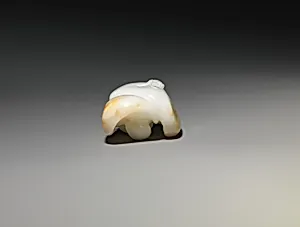
清 玉雕象生菌菇|Two mushrooms
Unknown Artist
18th century
Medium
Jade (nephrite)
Dimensions
L. 2 in. (5.1 cm)
Classification
Jade
Culture & Period
China · Qing dynasty (1644–1911)
Department
Asian Art
Museum
Metropolitan Museum of Art, New York, NY
Credit
Gift of Florence and Herbert Irving, 2015
Accession Number
2015.500.5.16
Rights
Public Domain
Tags
Art Historical Context
This exquisite jade carving, titled *Two Mushrooms* (清 玉雕象生菌菇), hails from 18th-century China during the Qing dynasty (4–1911). Carved from nephrite jade, a prized stone revered in Chinese culture for its associations with purity, immortality, and moral virtue, the piece measures just 2 inches (5.1 cm) in length. Its diminutive scale belies the artist's masterful skill in capturing the delicate, life-like forms of two mushrooms, complete with textured caps and slender stems—a technique known as *xiangsheng* (imitating life), where jade artisans mimicked nature with astonishing realism. In the Qing era, jade carving reached new heights of technical virtuosity, often commissioned for scholarly appreciation or as symbols of refined taste among the elite. Nephrite, prized for its toughness and subtle green hues, allowed carvers to exploit the stone's natural veining to enhance organic details, evoking the fungi's earthy freshness. Mushrooms held auspicious connotations in Chinese lore, symbolizing longevity and abundance, making this piece both a technical marvel and a cultural talisman. Now in the Metropolitan Museum of Art's Asian Art Department, thanks to the 2015 gift of Florence and Herbert Irving, it invites visitors to marvel at the Qing jade carver's patience and ingenuity—transforming unyielding stone into fleeting natural beauty.