
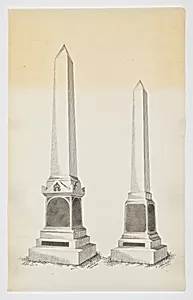
Two Obelisk Grave Monuments, Nos. 946, 1319
1840–80
Medium
Pen and ink on onion skin paper
Dimensions
Sheet: 29 3/4 × 18 1/2 in. (75.6 × 47 cm)
Classification
Drawings
Department
Drawings and Prints
Museum
Metropolitan Museum of Art, New York, NY
Credit
Bequest of Herbert Mitchell, 2008
Accession Number
2018.839.87
Rights
Public Domain
Tags
Art Historical Context
In the mid-19th century, Europe's fascination with ancient Egypt—sparked by Napoleon's expedition and the deciphering of hieroglyphs— artist Alexander Maxwell created meticulous drawings of Egyptian antiquities. *Two Obelisk Grave, Nos. 946, 1319* (1840–80) two towering obelisk-shaped funerary structures, likely from Nubia or Upper Egypt, where such forms symbolized eternity and divine protection for the deceased. These cataloged numbers suggest Maxwell's work was part of a systematic documentation effort, possibly for scholarly publications or museum records, reflecting the era's archaeological zeal. Rendered in pen and ink on delicate onion skin paper—a thin, translucent medium ideal for precise tracings and overlays—Maxwell's drawing exemplifies 19th-century topographical accuracy. The large sheet (29 3/4 × 18 1/2 in.) allows for intricate details of hieroglyphs, proportions, and textures, blending artistic skill with scientific precision. Housed in the Metropolitan Museum of Art's Drawings and Prints department through the 2008 bequest of Herbert Mitchell, this piece offers visitors a window into how Victorian explorers preserved vanishing monuments through paper and ink. Today, it highlights the cultural bridge between ancient rituals and modern preservation, reminding us how obelisks, once piercing the Nile sky, continue to inspire awe.