
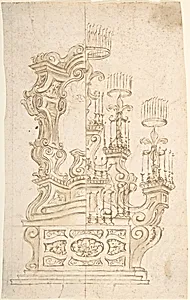
Two One Half Variant Designs for a Catafalque
Medium
Pen and brown ink, brush and brown wash, over leadpoint or graphite, with ruled construction
Dimensions
sheet: 12 1/2 x 7 13/16 in. (31.8 x 19.9 cm)
Classification
Drawings
Department
Drawings and Prints
Museum
Metropolitan Museum of Art, New York, NY
Credit
Gift of Leon Dalva Sr., 1965
Accession Number
65.654.106
Rights
Public Domain
Tags
Art Historical Context
This exquisite 18th-century drawing Piedmont, Italy, presents two and a half variant for a *catafalque*—an ornate, temporary platform used to elevate a coffin during grand funerals or memorial ceremonies. Created anonymously by a skilled Piedmontese artist between 1700 and 1780, it captures the era's emphasis on elaborate ceremonial architecture, where such structures served as symbols of mourning, prestige, and piety for nobility or clergy. Executed on a modest sheet measuring 12½ × 7⅞ inches, the work showcases meticulous preparatory techniques: faint leadpoint or graphite underdrawing for initial sketches, precise ruled construction lines for architectural accuracy, fluid penwork in brown ink for outlines, and subtle brown wash for modeling shadows and depth. Floral motifs, hinted at in the design, add a decorative flourish typical of Baroque-era opulence, blending solemnity with artistic elegance. Housed in the Metropolitan Museum of Art's Drawings and Prints department as a 1965 gift from Leon Dalva Sr., this anonymous gem offers a rare glimpse into the drafting process behind Piedmont's rich tradition of ephemeral funerary art, reminding us how drawings like this bridged imagination and monumental reality.