
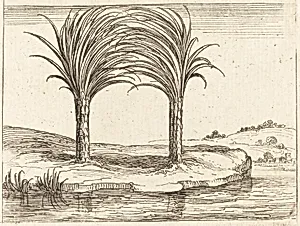
Two Palm Trees
1628
Medium
etching on laid paper
Dimensions
plate: 6.4 × 8.3 cm (2 1/2 × 3 1/4 in.) sheet: 8.8 × 10.2 cm (3 7/16 × 4 in.)
Classification
Department
CG-E
Museum
National Gallery of Art, Washington, D.C.
Credit
R.L. Baumfeld Collection
Accession Number
1969.15.589
Rights
Public Domain
Art Historical Context
In the intimate etching *Two Palm Trees* (1628), Jacques Callot captures the elegant sway of exotic palms with his signature precision. Created on laid paper—a period staple with its textured, chain-lined surface—this diminutive plate (just 6.4 × 8.3 cm) exemplifies the French Baroque master's prowess in printmaking. Callot, who honed his craft in Italy before returning to Lorraine, produced these small-scale landscapes as studies in nature's grace, blending realism with fanciful detail. Etching allowed Callot to achieve extraordinary finesse through multiple acid bitings, rendering slender fronds, textured bark, and subtle shadows in a web of fine lines. This technique, which he helped refine, made complex compositions possible on a tiny scale, inviting close inspection. Printed during a time of artistic innovation in Europe, the work reflects Callot's shift from grand battle scenes to serene vignettes, possibly evoking Mediterranean travels. Housed in the National Gallery of Art's R.L. Baumfeld Collection, *Two Palm Trees* showcases how prints democratized fine art, offering collectors portable beauty. Its quiet monumentality reminds us of nature's poetry, a timeless counterpoint to the era's upheavals.
About the Artist
Jacques Callot · 1592–1635
Jacques Callot (1592–1635) was a French printmaker and draftsman from the Duchy of Lorraine, widely regarded as one of the first great artists to practice the graphic arts exclusively. His more than 1,400 etchings chronicled the breadth of 17th-century life, from Medici court festivities to the brutal realities of warfare. Callot revolutionized etching through technical innovations including the é...