
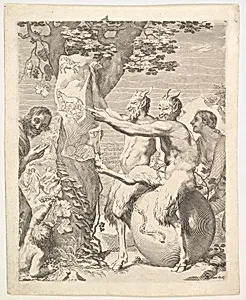
Two satyrs, traditionally known as the 'Mockers,' laughing and using their limbs to pin a drawing to a tree trunk, at left a smiling man points toward the drawing, at right is a laughing woman, a globe underneath one of the satyrs
ca. 1636–45
Medium
Engraving
Dimensions
sheet: 10 1/8 x 8 1/8 in. (25.7 x 20.7 cm) plate: 9 3/16 x 7 5/16 in. (23.3 x 18.5 cm)
Classification
Prints
Department
Drawings and Prints
Museum
Metropolitan Museum of Art, New York, NY
Credit
Bequest of Phyllis Massar, 2011
Accession Number
2012.136.44
Rights
Public Domain
Tags
Art Historical Context
In Claude Mellan's enchanting engraving *Two Satyrs, traditionally known as the 'Mock'* (ca. 1636–45), a lively scene unfolds in a wooded setting. Two mischievous satyrs—mythological half-man, half-goat symbolizing revelry and folly—laugh heartily while using their limbs to pin a to a tree trunk. the left, a smiling man points toward the affixed artwork, while at right, a laughing woman joins the amusement. Beneath one satyr rests a globe, hinting at worldly satire or the universality of mockery. Mellan, a masterful French engraver active during the Baroque era, was renowned for his virtuoso line work, often creating intricate images with astonishing precision on copper plates. This print exemplifies his technical prowess: fine, expressive lines capture dynamic movement, exaggerated expressions, and textured foliage, all within a modest plate size of 9 3/16 x 7 5/16 inches. Engravings like this were prized in 17th-century Europe for their reproducibility, allowing satirical or humorous subjects to reach wide audiences beyond paintings. The 'Mockers' playfully critiques the pretensions of art itself, with satyrs deriding a human drawing amid human onlookers' glee. Housed in The Metropolitan Museum of Art's Drawings and Prints department (Bequest of Phyllis Massar, 2011), it invites visitors to chuckle at the timeless folly of creation and criticism.
About the Artist
Claude Mellan · 1598–1688
Claude Mellan (1598-1688) was a French draughtsman, engraver, and painter who became one of the most innovative printmakers of the French Baroque period. Born in Abbeville to a family of coppersmiths, Mellan rose to become Peintre et Graveur Ordinaire du Roi (Painter and Engraver in Ordinary to the King), achieving recognition for his extraordinary technical mastery. Mellan's artistic significanc...