
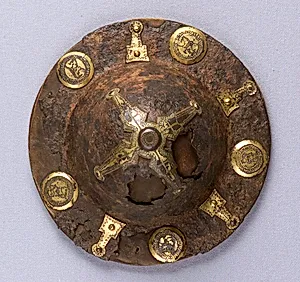
Two Shield Bosses (Umbos)
Unknown Artist
7th century
Medium
Iron, copper alloy, gold
Dimensions
1984.184.1: Diam. 7 1/2 in. (19.05 cm); D. 3 1/2 in. (8.89 cm); 1984.184.2: Diam. 7 in. (17.78 cm); D. 3 1/2 in. (8.89 cm)
Classification
Shields
Culture
Western European, Langobardic
Department
Arms and Armor
Museum
Metropolitan Museum of Art, New York, NY
Credit
Purchase, Rogers Fund and Bequest of Stephen V. Grancsay, by exchange, 1984
Accession Number
1984.184.1, .2
Rights
Public Domain
Art Historical Context
These striking 7th-century shield bosses, or *umbos*, from the Langobardic culture of Western Europe, served as both functional protectors and symbols of warrior status. Crafted with an iron core for durability, they feature copper alloy sheathing and gold accents, highlighting the Lombards'—a Germanic people who dominated northern Italy after the fall of Rome—mastery of metalworking. Measuring about 7 inches in diameter and 3.5 inches deep, these domed centers would have protruded from wooden shields, guarding the bearer's hand while allowing for aggressive combat thrusts. Langobardic artifacts like these are rare survivors from the turbulent Early Middle Ages, offering a glimpse into a warrior society blending Roman influences with Germanic traditions. The lavish use of precious gold suggests they belonged to elite fighters, perhaps chieftains, underscoring how arms were displays of power and artistry amid constant raids and conquests. Displayed in the Metropolitan Museum of Art's Arms and Armor department, they evoke the clang of battles from over 1,300 years ago, reminding us of the craftsmanship that armed Europe's medieval dawn.