
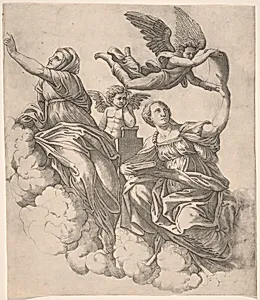
Two Sibyls and an Angel
Medium
engraving on laid paper
Classification
Department
CG-E
Museum
National Gallery of Art, Washington, D.C.
Credit
Ailsa Mellon Bruce Fund
Accession Number
2019.63.2
Rights
Public Domain
Art Historical Context
In the National Gallery of Art's collection, *Two Sibyls and an Angel* (c. 1520s) is a masterful engraving by Giovanni Antonio da Brescia a leading Italian printmaker of the High Renaissance, created after a design by the incomparable Raphael. Sibyls—ancient prophetesses from classical mythology—were popular subjects in Renaissance art,izing divine wisdom and bridging pagan antiquity with Christian themes. Here, two graceful sibyls flank a tender angel, evoking Raphael's signature elegance and harmonious compositions, likely inspired by his Vatican frescoes or lost drawings. Da Brescia's engraving technique on laid paper exemplifies the era's reproductive printmaking revolution. Using intricate burin work, he meticulously translated Raphael's fluid lines and subtle modeling into tonal depth, making elite art accessible to a broader audience through affordable prints. This medium's durability and portability spread Renaissance ideals across Europe, influencing artists from Dürer to later engravers. Acquired through the Ailsa Mellon Bruce Fund, this print highlights the technical virtuosity of 16th-century Italy, where copies honored originals while preserving their spiritual aura for generations of admirers.