
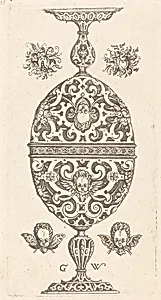
Two small goblets superimposed in reverse
published 1579
Medium
engraving
Classification
Department
CG-E
Museum
National Gallery of Art, Washington, D.C.
Credit
Rosenwald Collection
Accession Number
1943.3.8392
Rights
Public Domain
Art Historical Context
Georg Wechter I, a German engraver of the late Renaissance, created *Two Small Goblets Superimposed in Reverse* in 157. This intricate engraving, housed in the National Gallery of's Rosenwald Collection ( CG-E), exemplifies the period's fascination with ornamental designs for luxury metalwork. Wechter, part of a noted family of artists in Nuremberg, specialized in prints that served as pattern books for goldsmiths and silversmiths, bridging art and craft. The composition cleverly overlays two goblets in mirror-image fashion, showcasing the precision of engraving—a technique where a burin carves fine lines into a metal plate for inked impressions. This allowed for exquisite detail in depicting facets, scrolls, and motifs typical of Mannerist silverware, reflecting the era's opulent tastes influenced by Italian Renaissance forms adapted in Northern Europe. Such prints held cultural importance as they democratized elite designs, enabling workshops across Europe to replicate sophisticated vessels. Visitors will appreciate how Wechter's work captures the ingenuity of 16th-century design, where illusion and symmetry turned functional objects into artistic marvels.