
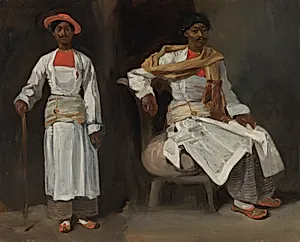
Two Studies of an Indian from Calcutta, Seated and Standing
c. 1823/1824
Medium
oil on canvas
Dimensions
overall: 37.5 x 45.7 cm (14 3/4 x 18 in.) framed: 51.1 x 59.5 x 3.8 cm (20 1/8 x 23 7/16 x 1 1/2 in.)
Classification
Painting
Department
CF
Museum
National Gallery of Art, Washington, D.C.
Credit
Collection of Mr. and Mrs. Paul Mellon
Accession Number
2006.128.19
Rights
Public Domain
Art Historical Context
In the early 1820s, Eugène Delacroix, a pioneering French Romantic painter, captured the exotic allure of distant cultures in *Two Studies of an Indian Calcutta, Seated and* (c. 1823/1824). This oil on canvas work, measuring 37.5 x 45.7 cm, presents two poised figures—one seated thoughtfully, the other standing gracefully—rendered with fluid brushstrokes that emphasize movement and vitality over precise detail. Delacroix's use of oil for these studies was innovative, allowing him to explore rich color harmonies and luminous skin tones that foreshadow his later masterpieces. Created during a period when Romanticism rebelled against Neoclassicism's rigid forms, the painting reflects Europe's growing fascination with Orientalism, fueled by colonial expansion. Calcutta, a bustling British outpost in India, symbolized the mysterious East. Delacroix's keen observation of the sitter's turban, jewelry, and contemplative expression highlights his ethnographic curiosity, even before his transformative 1832 trip to North Africa. These studies showcase his loose, expressive technique—vibrant impasto and dynamic poses—that prioritized emotion and individualism. Today, housed in the National Gallery of Art as part of the Collection of Mr. and Mrs. Paul Mellon, this gem invites visitors to appreciate Delacroix's genius for bridging cultures through art, blending technical mastery with a sense of wonder.
About the Artist
Eugène Delacroix · 1798–1863
Eugène Delacroix (1798–1863) stands as the defining figure of French Romanticism and a pivotal bridge to modernism. Born in Charenton-Saint-Maurice near Paris, he came from distinguished lineage—his mother descended from the prestigious Oeben-Riesener furniture dynasty, while persistent speculation suggested the statesman Talleyrand may have been his biological father, a theory supported by physic...