
Two Swans
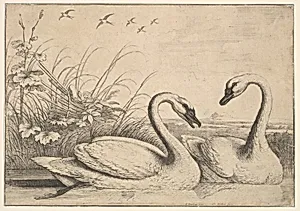
Medium
Etching; second state of two
Dimensions
Sheet: 5 3/16 × 7 7/16 in. (13.2 × 18.9 cm) cut outside the image but within the platemark
Classification
Prints
Department
Drawings and Prints
Museum
Metropolitan Museum of Art, New York, NY
Credit
Harris Brisbane Dick Fund, 1917
Accession Number
17.3.2858
Rights
Public Domain
Tags
Art Historical Context
"Two Swans," an exquisite etching created between 1654 and 1658, showcases a remarkable collaboration between Bohemian-born master etcher Wenceslaus Hollar and English artist Francis Barlow. Hollar, renowned for his meticulous reproductive prints, translated Barlow's design—a specialist animal and bird illustrations—into this second state of, measuring about 5¼ × 7½ inches. Housed in the Metropolitan Museum Art's Drawings and Prints department, this work exemplifies the artistry of mid-17th-century print. Etching, a technique using acid to bite lines into a metal plate, allowed Hollar to capture the swans' graceful forms with extraordinary delicacy. The birds glide elegantly across the water, their feathers rendered in fine, swirling lines that suggest subtle movement and lifelike texture. This state likely includes refinements from the first, enhancing the image's clarity within the platemark. In an era of growing fascination with the natural world, "Two Swans" reflects the era's scientific curiosity and aesthetic appreciation for wildlife. Swans, symbols of purity and serenity, were popular subjects, and this print's portability made it accessible to collectors. A testament to Anglo-Continental artistic exchange during England's turbulent Commonwealth period, it invites visitors to marvel at the enduring beauty of these noble creatures frozen in ink.
About the Artist
Wenceslaus Hollar|Francis Barlow · 1607–1677
Wenceslaus Hollar (1607-1677) was a prolific Bohemian etcher who became one of the most accomplished printmakers of the seventeenth century. Born in Prague, he trained under Matthäus Merian in Frankfurt before entering the service of Thomas Howard, Earl of Arundel, in 1636. Hollar spent most of his career in England, where he produced approximately 2,740 etchings documenting an extraordinary range...