
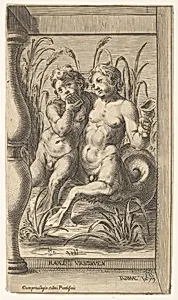
Two tritons embracing, one playing a panpipe, the second holding a conch shell set within a recessed space
Medium
Engraving
Dimensions
Sheet: 7 13/16 x 4 1/2 in. (19.8 x 11.5 cm)
Classification
Prints
Department
Drawings and Prints
Museum
Metropolitan Museum of Art, New York, NY
Credit
Bequest of Phyllis Massar, 2011
Accession Number
2012.136.830
Rights
Public Domain
Tags
About this artwork
Cherubino Alberti (Zaccaria Mattia)|Raphael (Raffaello Sanzio or Santi)'s "Two tritons embracing, one playing a panpipe, the second holding a conch shell set within a recessed space" (1579) The work, executed in engraving, measures sheet: 7 13/16 x 4 1/2 in. and Prints served crucial roles in disseminating artistic ideas and images across geographic and social boundaries. This work provides valuable insights into Cherubino Alberti (Zaccaria Mattia)|Raphael (Raffaello Sanzio or Santi)'s artistic ...
Art Historical Context
In the Metropolitan Museum of Art's Drawings and Prints department, Cherubino Alberti's 1579 engraving *Two Tritons Embracing, One Playing a Panpipe, Second Holding a Conch Set Within a Recessed* captures a lively mythological scene. Attributed to a design by the High Renaissance master Raphael (affaello Sanzio), showcases Alberti's skill as a Mannerist engraver in faithfully reproducing classical motifs. Measuring just 7 13/16 x 4 1/2 inches on its sheet, this intimate print draws viewers into a recessed niche where muscular tritons—sea deities from Greek mythology—embrace playfully, one blowing a panpipe while the other grasps a conch shell trumpet. Engravings like this were revolutionary in the late 16th century, serving as affordable "reproductions" that spread Raphael's influential compositions across Europe, bridging geographic and social divides. Alberti, a prolific Roman printmaker, specialized in such afterimages, preserving Renaissance ideals of harmony and humanism amid emerging Mannerist dynamism. The musical instruments highlight themes of revelry and the sea's enchantment, evoking ancient festivals. This bequest from Phyllis Massar offers a window into how prints fueled artistic exchange, making elite designs accessible to collectors and inspiring generations of artists. A delightful blend of myth and mastery!
About the Artist
Cherubino Alberti (Zaccaria Mattia)|Raphael (Raffaello Sanzio or Santi) · 1553–1615
Cherubino Alberti (1553–1615), also known by his birth name Zaccaria Mattia, was an Italian engraver and painter active in Rome during the late Renaissance and early Baroque periods. Born in Borgo San Sepolcro in Tuscany, he came from an artistically inclined family and received training that equipped him for work in both painting and the reproductive graphic arts. It was as a printmaker, however,...