
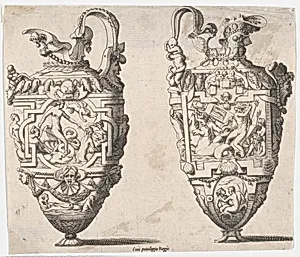
Two Vases
16th–17th century
Medium
Engraving
Dimensions
Sheet: 5 7/16 × 6 7/16 in. (13.8 × 16.4 cm)
Classification
Prints
Department
Drawings and Prints
Museum
Metropolitan Museum of Art, New York, NY
Credit
Bequest of Herbert Mitchell, 2008
Accession Number
2018.839.54
Rights
Public Domain
Art Historical Context
René Boyvin’s engraving “Two Vases” captures the refined ornamental tastes of the late Renaissance and early Baroque eras. Created as a print on a modest sheet measuring roughly five and a half by six and a half inches, the work demonstrates how engravers translated sculptural ideas into portable, reproducible designs. Boyvin, active in France during the sixteenth and seventeenth centuries, specialized in such decorative motifs, allowing goldsmiths, ceramists, and patrons across Europe to study and adapt elegant vessel forms. Engraving was prized in this period for its precision and ability to circulate artistic models widely. Each fine line could suggest the gleam of metal or the curve of a handle, turning the printed page into a practical pattern book. Viewers today can appreciate both the technical mastery required to render balanced compositions on such a small scale and the cultural role these prints played in spreading Renaissance ideals of symmetry and classical ornament. Now part of the Metropolitan Museum of Art’s collection of drawings and prints through the bequest of Herbert Mitchell, “Two Vases” offers a quiet window into how everyday objects became vehicles for artistic innovation and shared taste.
About the Artist
René Boyvin · 1525–1580
French, Angers ca. 1525–1598 or 1625/6 Angers