
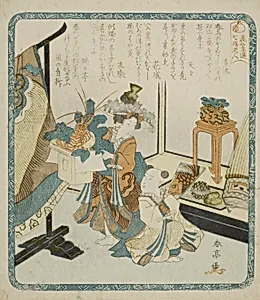
Two Young Attendants on New Year's Day from the series "Seven Women as the Gods of Good Fortune for the Hanagasa Poetry Club (Hanagasaren shichifukujin)"
c. 1820
Medium
Color woodblock print; shikishiban, surimono
Dimensions
20.5 × 18.1 cm (8 1/16 × 7 1/8 in.)
Classification
woodblock print
Department
Arts of Asia
Museum
Art Institute of Chicago
Accession Number
30589
Rights
Public Domain
Art Historical Context
In the vibrant world of Edo-period Japan (1603–1868), Katsukawa Shuntei (0–1820) crafted this exquisite color woodblock print around 1820 as part of the series *Seven Women as the Gods of Good for the Hanagasa Club (Hanagasaren shifukujin)*. Shuntei, a master of the ukiyo-e tradition from the Katsukawa school, in graceful depictions of women and theatrical scenes. This *shikishiban surimono*—a, square-format print often privately commissioned for New Year's celebrations or poetry gatherings—measures a intimate 20.5 × 18.1 cm, perfect for personal albums. Titled *Two Young Attendants on New Year's Day*, the print captures two young *kamuro* (attendants to courtesans) in festive attire, evoking the joyous spirit of Oshōgatsu, Japan's traditional New Year. Surimono like this were prized for their refined techniques: hand-applied colors, subtle embossing, and sometimes mica for a shimmering effect, reserved for elite poetry clubs like Hanagasa-ren. The series reimagines the Shichifukujin—the Seven Gods of Good Fortune—as elegant women, blending folklore with contemporary beauty ideals to wish prosperity and poetic inspiration. Housed in the Art Institute of Chicago's Arts of Asia collection, this work highlights surimono's cultural role in fostering literati communities, where printed poems and art intertwined. Shuntei's delicate lines and harmonious compositions make it a window into Japan's playful fusion of myth, seasonality, and artistry.
About the Artist
Katsukawa Shuntei · 1770–1820
Katsukawa Shuntei (1770–1820), originally named Yamaguchi Chōjūrō, was a versatile ukiyo-e printmaker of Japan's Edo period under the Tokugawa shogunate. His early life remains sparsely documented, but by the late 1790s, he had entered the prestigious Katsukawa school, studying under the master Katsukawa Shun'ei, who led the school following the death of founder Shunshō. Shuntei's earliest authent...