
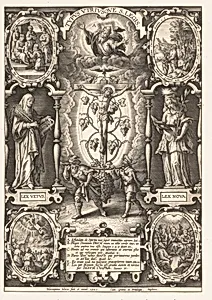
Typus Utriusque S. Legis
1570–1619
Medium
Engraving
Classification
Prints
Department
Drawings and Prints
Museum
Metropolitan Museum of Art, New York, NY
Credit
The Elisha Whittelsey Collection, The Elisha Whittelsey Fund, 1951
Accession Number
51.501.6396
Rights
Public Domain
Tags
Art Historical Context
**Typus Utriusque S. Legis** is a striking engraving by Hieronymus (Jerome) Wierix, a masterful Flemish printmaker active between 1570 and 1619. Part of the prolific Wierix family workshop in Antwerp, Jerome specialized in intricate miniature engravings that brought religious devotion to the masses during the Counter-Reformation era This work, housed in the Metropolitan Museum of Art Drawings and Prints department, exemplifies the technique of engraving—where fine lines are incised into a copper plate, inked, and pressed onto paper—allowing for exceptional detail in small formats ideal for personal prayer books or altarpieces. The title, Latin for "Type [or Emblem] of Both Holy Laws," likely symbolizes the harmony between the Old and New Testaments, a common Christian motif. Tags highlighting women, the Cross, and Christ suggest depictions of key female figures—perhaps the Virgin Mary or Saint Veronica—alongside the crucified Savior, visually bridging Mosaic Law with Gospel grace. Such typological imagery reinforced Catholic doctrine amid Protestant challenges, making it culturally vital for spiritual instruction. Wierix's precise lines capture emotional depth and symbolic richness, reflecting Mannerist tendencies toward elegance and complexity. Acquired through The Elisha Whittelsey Fund in 1951, this print invites visitors to ponder faith's enduring visual language, a testament to 16th-century artistry's devotional power.