
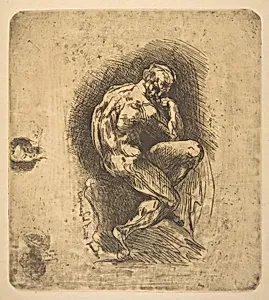
Ugolino
Medium
Etching
Dimensions
Sheet: 10 7/8 × 8 7/16 in. (27.7 × 21.4 cm) Plate: 7 3/8 × 6 5/8 in. (18.8 × 16.8 cm)
Classification
Prints
Department
Drawings and Prints
Museum
Metropolitan Museum of Art, New York, NY
Credit
The Elisha Whittelsey Collection, The Elisha Whittelsey Fund, 1989
Accession Number
1989.1155
Rights
Public Domain
Tags
Art Historical Context
Jean-Baptiste Carpeaux *Ugolino* (1860) is a striking etching that captures the French sculptor's mastery of the male nude, drawing from Dante's *Inferno*. The print depicts Ugolino della Gherardes, the tragic Tuscan noble condemned to starve in a tower with his sons, a tale of paternal anguish and horror that gripped 19th-century Romantic imaginations. Carpeaux, a leading figure of Second Empire France, often explored dramatic human suffering through dynamic anatomy, blending Realism's precision with Romantic intensity—evident here in the taut muscles and expressive torment of the figures. Created as an etching, this work showcases Carpeaux's versatility beyond sculpture. Etching allowed him to translate his sculptural vision into intimate print form, using acid-bitten lines for rich tonal depth and intricate details within the modest plate size (7 3/8 × 6 5/8 in.). Prints like this democratized access to his art, bridging elite sculpture with broader audiences during Paris's cultural boom under Napoleon III. Housed in the Metropolitan Museum of Art's Drawings and Prints department, part of The Elisha Whittelsey Collection, *Ugolino* exemplifies Carpeaux's Prix de Rome-honed skill in anatomical drama. A poignant reminder of literature's enduring influence on visual art, it invites visitors to ponder the raw vulnerability of the human form.
About the Artist
Jean-Baptiste Carpeaux · 1827–1875
Carpeaux's exuberant work was a decisive break from Neoclassical art. He won the Prix de Rome in 1854 and received many portrait bust commissions from the court. His most famous sculpture group is 'La Danse' (1869) made for the Paris Opéra. So bold is its message of bacchanalian revelry that it was vandalized in protest. French artist.