
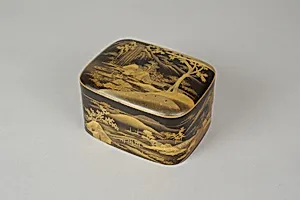
Ukifune, (from) "Genji monogatari"|Scene from A Boat upon the Waters, a Chapter from "The Tale of Genji"
Unknown Artist
19th century
Medium
Gold makie (sprinkled) design on black lacquer
Dimensions
H. 2 5/8 in. (6.7 cm); W. 3 5/8 in. (9.2 cm); D. 4 5/6 in. (12.3 cm)
Classification
Lacquer
Culture & Period
Japan · Meiji period (1868–1912)
Department
Asian Art
Museum
Metropolitan Museum of Art, New York, NY
Credit
Bequest of Stephen Whitney Phoenix, 1881
Accession Number
81.1.214
Rights
Public Domain
Tags
Art Historical Context
This exquisite lacquer box, titled *Ukifune* from *Genji monogatari* (The Tale of Genji), captures a poignant scene from the chapter "A Boat upon the." Created by an unknown artist during Japan's Meiji period (186–1912), it elements like houses, bridges,, and trees, ev the dramatic exile of the heroine Ukif on a river journey. The Tale of Genji, written by Murasaki Shik in the 11th, is the world's first novel and a cornerstone of Japanese literature, with its romantic and melancholic episodes inspiring countless artworks across centuries. Crafted as a small, portable object—measuring just 2⅝ × 3⅝ × 4⅞ inches—this piece showcases the refined art of gold *makie* (sprinkled gold) on black lacquer. *Makie* involves meticulously sprinkling fine gold powder onto wet lacquer, then polishing it to a luminous sheen, a technique perfected over centuries that symbolizes Japan's mastery of lacquerware. During the Meiji era, as Japan opened to the West, such luxury items blended traditional motifs with emerging global influences, highlighting cultural resilience amid modernization. Housed in the Metropolitan Museum of Art's Asian Art Department (bequest of Stephen Whitney Phoenix, 1881), this box invites visitors to ponder the enduring allure of Genji's world—where nature mirrors human emotion—preserved in shimmering gold against ebony depths. A testament to Japan's artistic heritage, it bridges Heian-era tales with 19th-century ingenuity.