
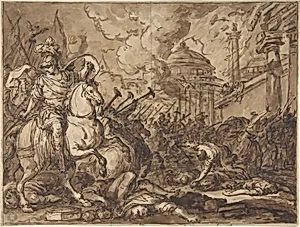
Ulysses Entering Troy
Medium
Recto: Pen and brown ink, brush and brown wash; Verso: faint black chalk sketch of same subject
Dimensions
8-3/4 x 11-1/2 in. (22.2 x 29.2 cm)
Classification
Drawings
Department
Drawings and Prints
Museum
Metropolitan Museum of Art, New York, NY
Credit
Gift of Philippe and Edith de Montebello, 1998
Accession Number
1998.388
Rights
Public Domain
Tags
Art Historical Context
In the dramatic drawing *Ulysses Entering Troy French artist Antoine François Callet captures a pivotal from Homer's *Iad* and the Trojan saga. Created in the1780s, this depicts the cunning Greek hero (Ulysses) the besieged city of Troy amid scenes of warfare,, fallen men, and horses. Callet's choice subject reflects the era's fascination with classical antiquity fueling neoclassical art that celebrated heroic narratives and moral from ancient myths. Executed on both sides of the sheet, the recto features precise pen and brown ink lines enhanced by fluid brush and brown wash, depth, shadow, and dynamic movement in the chaotic battle. The verso reveals a faint black chalk underdrawing of the same composition, offering a rare glimpse into Callet's preparatory process—a common practice among 18th-century draftsmen sketching ideas for larger paintings or engravings. At just 8-3/4 x 11-1/2 inches, its intimate scale invites close inspection of the intricate details. Housed in the Metropolitan Museum of Art's Drawings and Prints department (gift of Philippe and Edith de Montebello, 1998), this piece highlights the technical virtuosity of French draftsmanship during the late Enlightenment, bridging myth and history for modern viewers.