
Un Ennemi du peuple
1893
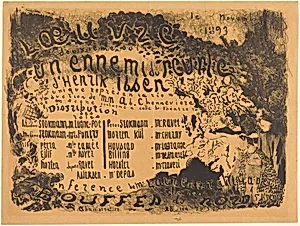
Medium
lithograph in black on brown wove paper
Dimensions
sheet: 24.3 x 32.2 cm (9 9/16 x 12 11/16 in.)
Classification
Department
CG-E
Museum
National Gallery of Art, Washington, D.C.
Credit
Gift of The Atlas Foundation
Accession Number
1995.76.109
Rights
Public Domain
Art Historical Context
Édouard Vuillard's 1893 lithograph *Un Ennemi du peuple* reflects the intimate, atmospheric approach that marked his place among the Nabis, a group of Post-Impressionist artists who valued decorative pattern, mood, and the integration of art into everyday life. Printed in black on brown wove paper, the modest sheet (just under 10 by 13 inches) demonstrates lithography's appeal for Vuillard: the medium's greasy crayon and tusche washes could capture the sketch-like, velvety tones he favored in his paintings of interiors and quiet observation. The title, French for “An Enemy of the People,” echoes Henrik Ibsen's socially charged play, a work that circulated in Parisian literary and theatrical circles at the time. Vuillard, closely connected to writers and the experimental Théâtre de l'Œuvre, frequently turned to such subjects, using printmaking to explore narrative suggestion rather than grand statement. Lithography suited this intimate scale, allowing multiple impressions while preserving a handmade, almost private quality. This impression, a gift of The Atlas Foundation to the National Gallery of Art, offers a window onto Vuillard's early print experiments and the Nabis' belief that even a small, economical work could convey psychological depth and cultural conversation. It invites viewers to consider how late-nineteenth-century artists bridged painting, literature, and the stage.
About the Artist
Edouard Vuillard · 1868–1940
Jean-Édouard Vuillard was born on November 11, 1868, in Cuiseaux, Saône-et-Loire, France, to a retired naval captain father and seamstress mother, Marie Vuillard. After his father's early death in 1884, the family settled in Paris, where Vuillard attended the Lycée Condorcet, meeting future Nabis members like Ker-Xavier Roussel—later his brother-in-law—and Maurice Denis. He began formal training i...