
Under a Peach Tree
c. 1766
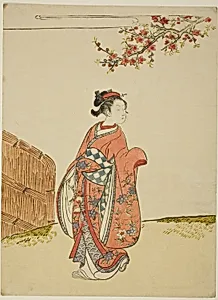
Medium
Color woodblock print; left sheet of chuban diptych
Dimensions
28 × 20.7 cm (11 × 8 1/8 in.)
Classification
woodblock print
Department
Arts of Asia
Museum
Art Institute of Chicago
Accession Number
20832
Rights
Public Domain
Art Historical Context
Suzuki Harunobu's *Under a Peach Tree*c. 1766) is a captivating color woodblock print, left sheet of a ch diptych measuring 28 × 20.7 cm. As one of Japan's pioneering ukiyo-e artists, Harunobu revolutionized printmaking during the Edo period introducing full-color *nishiki-e* ("brocade pictures") 1765. These vibrant works captured the "floating" of urban pleasures in Edo (modern Tokyo), blending delicate beauty with everyday elegance. The chuban format—smaller and more affordable than larger prints—made such art accessible to a wider audience, from merchants to samurai. Harunobu's signature style shines in his intimate portrayals of women (*bijin-ga*), often set against poetic natural backdrops like blooming peach trees, evoking spring's fleeting beauty and subtle sensuality. The woodblock technique involved multiple carved blocks inked in precise colors, layered to create luminous gradients and textures—a technical marvel that influenced global art, from Impressionism to Japonisme. This diptych half invites viewers to imagine its companion sheet, completing a harmonious scene of tranquility and desire. Housed in the Art Institute of Chicago's Arts of Asia department, *Under a Peach Tree* exemplifies Harunobu's brief but brilliant career (1725–1770), producing over 500 designs that defined ukiyo-e's golden age. It's a window into 18th-century Japanese culture, where art celebrated life's ephemeral joys.
About the Artist
Suzuki Harunobu · 1725–1770
Suzuki Harunobu (c. 1725-1770) was a Japanese ukiyo-e artist who revolutionized woodblock printing by developing nishiki-e—full-color prints using multiple woodblocks—in 1765. Before Harunobu, Japanese prints were limited to two or three colors; his innovation unleashed the entire artist's palette, transforming ukiyo-e into the vibrant art form that would later captivate Western artists from Manet...