
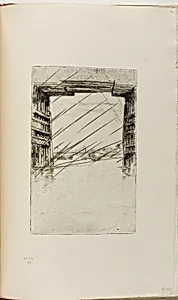
Under Old Battersea Bridge
1876/78
Medium
Etching, drypoint and open bite, with foul biting, with drypoint cancellation, in black ink on ivory laid paper
Dimensions
Plate: 21.4 × 13.8 cm (8 7/16 × 5 7/16 in.); Sheet, sight, bound: 37.9 × 24 cm (14 15/16 × 9 1/2 in.)
Classification
etching
Department
Prints and Drawings
Museum
Art Institute of Chicago
Accession Number
190734
Rights
Public Domain
Art Historical Context
James McNeill Whistler’s *Under Old Battersea Bridge* (1876/78) captures a moody glimpse of London’s industrial Thames River, viewed from beneath the aging Battersea Bridge. As an American expatriate who made his home in Britain, Whistler was captivated by the river’s shifting lights and fog-shrouded banks during the late Victorian era. This etching belongs to his celebrated Thames series, where he elevated everyday urban scenes into poetic visions, aligning with his Aesthetic movement mantra of “art for art’s sake and subtle tonal harmonies over narrative detail. Printed in black ink on creamy ivory laid paper, the work showcases Whistler’s mastery of intaglio techniques: precise etching for lines, drypoint for velvety burrs, open bite for expansive tonal areas, and even “foul biting”—accidental acid textures that add gritty authenticity. The drypoint cancellation prevented further printings, making each impression uniquely atmospheric. Measuring a compact 21.4 × 13.8 cm on the plate, it exemplifies how Whistler revolutionized printmaking, rivaling paintings in evocativeness. Housed in the Art Institute of Chicago’s Prints and Drawings department, this piece invites visitors to ponder the bridge’s “old” moniker amid 1870s modernization, blending technical innovation with Whistler’s enduring quest for visual harmony.
About the Artist
James McNeill Whistler · 1834–1903
James Abbott McNeill Whistler (1834-1903) was an American-born painter and printmaker who became a leading figure in the Aesthetic Movement and pioneer of Tonalism and Japonisme. He revolutionized art by championing "art for art's sake" and treating paintings as visual equivalents of musical compositions, titling works as "arrangements," "harmonies," and "nocturnes" to emphasize formal qualities o...