
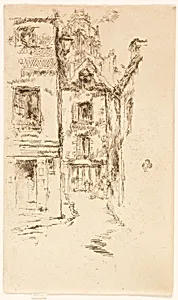
Under the Cathedral, Blois
Medium
Etching with foul biting in dark brown ink on ivory laid paper
Dimensions
Image, trimmed within platemark: 21.6 × 12.9 cm (8 9/16 × 5 1/8 in.); Sheet: 21.9 × 12.9 cm (8 5/8 × 5 1/8 in.)
Classification
etching
Department
Prints and Drawings
Museum
Art Institute of Chicago
Accession Number
20027
Rights
Public Domain
Art Historical Context
James McNeill Whistler’s *Under the Cathedral, Blo* (1888) captures the shadowy intrigue of the Cathedral of Saint-Louis in Blois, France—a Renaissance gem in the Loire Valley Created during Whistler’s travels through northern France, this etching reflects his fascination with atmospheric urban scenes, evoking a sense of quiet mystery beneath the soaring Gothic arches. As a master of the Aesthetic movement,istler prioritized subtle tonal harmonies and "art for art’s," distilling the cathedral’s grandeur into evocative simplicity. The work exemplifies Whistler’s innovative etching technique, where acid bites into a copper plate to create delicate lines. Here, "foul biting"—unintended acid corrosion—adds rich, textured depth in dark brown ink on creamy ivory laid paper, enhancing the moody interplay of light and shadow. Trimmed close to the platemark at just 21.6 × 12.9 cm, it invites intimate viewing, a hallmark of Whistler’s printmaking that revitalized etching as fine art in the late 19th century. Housed in the Art Institute of Chicago’s Prints and Drawings collection, this piece showcases Whistler’s influence on modern graphic arts, blending technical precision with poetic suggestion. Visitors will appreciate how it transports you to Blois’s historic streets, whispering of time’s gentle passage.
About the Artist
James McNeill Whistler · 1834–1903
James Abbott McNeill Whistler (1834-1903) was an American-born painter and printmaker who became a leading figure in the Aesthetic Movement and pioneer of Tonalism and Japonisme. He revolutionized art by championing "art for art's sake" and treating paintings as visual equivalents of musical compositions, titling works as "arrangements," "harmonies," and "nocturnes" to emphasize formal qualities o...