
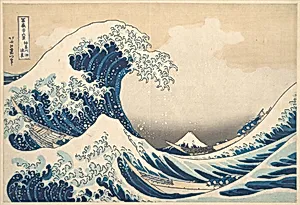
「富嶽三十六景 神奈川沖浪裏」|Under the Wave off Kanagawa (Kanagawa oki nami ura), or The Great Wave, from the series Thirty-six Views of Mount Fuji (Fugaku sanjūrokkei)
Katsushika Hokusai, ca. 1830–32
About this artwork
Katsushika Hokus's *Under the Wave off Kanagawa*, often called *The Great Wave*, is the iconic flagship print from his groundbreaking series *Thirty-six Views of Mount Fuji* (ugaku sanjūrokkei), created around 1830–32 during Japan's Edo period (1615–1868). This woodblock print, measuring about 10 x 15 inches, captures a dramatic seascape where towering waves threaten three boats laden with fishermen, while the distant peak of Mount Fuji looms serenely under a stormy sky. Hokusai, a master of ukiyo-e—the "pictures of the floating world"—revolutionized landscape art by emphasizing nature's raw power over human drama. Printed with vibrant inks on paper through a meticulous collaborative process involving carvers and printers, the work showcases Hokusai's innovative techniques: bold composition, dynamic perspective inspired by Western prints, and striking use of Prussian blue for depth and movement. As part of a series that popularized Mount Fuji as a cultural symbol of endurance and beauty, it reflects Edo Japan's fascination with travel, nature, and the ephemeral. Today, housed in the Metropolitan Museum of Art, *The Great Wave* endures as one of the most reproduced images worldwide, embodying Japan's artistic ingenuity and the timeless tension between humanity and the sea. Visitors are drawn to its energy, a testament to Hokusai's enduring genius at age 70.