
Underweysung der Messung (Nuremberg, 1538)
1538, 1527, 1532
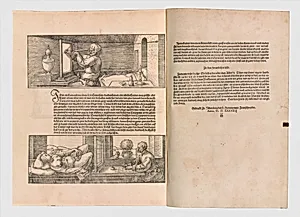
Medium
Woodcuts
Dimensions
12 9/16 × 8 7/16 × 1 13/16 in. (31.9 × 21.5 × 4.6 cm)
Classification
Books
Department
Drawings and Prints
Museum
Metropolitan Museum of Art, New York, NY
Credit
Gift of Felix M. Warburg, 1918
Accession Number
18.58.3
Rights
Public Domain
Tags
About this artwork
This books exemplifies the artistic traditions of its period. Created 1538, 1527, 1532, it demonstrates the woodcuts technique characteristic of its era.
Art Historical Context
Albrecht Dürer's *Underweysung derung*, published in Nuremberg in 1538, stands as a landmark treatise on the principles of measurement in art, drawing from his earlier studies around 1527 and 1532. This innovative book, gifted to the Metropolitan Museum of Art in 8, belongs to the Drawings and Prints department and exemplifies the Northern Renaissance master's fusion of art and science. Dürer, renowned for bridging Italian Renaissance ideals with German precision, used it to instruct artists on geometry, perspective, and human proportions—essential tools for creating lifelike figures. Printed as a compact volume measuring 12 9/16 × 8 7/16 × 1 13/16 inches, the work features intricate woodcuts, a technique Dürer perfected to achieve remarkable detail and tonal depth through carved wooden blocks. These illustrations, including depictions of men and female nudes, served as practical models for rendering the body accurately, reflecting the era's growing emphasis on empirical observation and classical anatomy. As one of Dürer's final major publications (posthumously issued after his 1528 death), it underscores the cultural shift toward technical treatises that democratized artistic knowledge via affordable prints. Visitors will appreciate how this book not only showcases Dürer's virtuosity but also advanced the woodcut medium, influencing generations of artists in an age of discovery.
About the Artist
Albrecht Dürer|Albrecht Dürer · 1471–1528
Albrecht Dürer (1471–1528) stands as the preeminent figure of the Northern Renaissance and arguably the most influential artist in the history of printmaking. Born in Nuremberg on May 21, 1471, and dying in the same city on April 6, 1528, Dürer revolutionized the status of the artist in Northern Europe, transforming printmaking from a commercial craft into an independent fine art and establishing ...