
Uninscribed Scarab of Sithathoryunet
Unknown Artist
ca. 1887–1813 B.C.
Medium
Lapis-lazuli
Dimensions
l. 1.7 cm (11/16 in)
Classification
Scarab, Sithathoryunet
Period
Middle Kingdom
Department
Egyptian Art
Museum
Metropolitan Museum of Art, New York, NY
Credit
Purchase, Rogers Fund and Henry Walters Gift, 1916
Accession Number
16.1.23
Rights
Public Domain
Tags
Art Historical Context
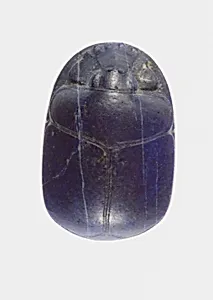
Behold the **Uninscribed Scarab of Sithathoryunet**, a petite jewel from ancient Egypt's Middle Kingdom (. 1887–1813 B.C.), crafted during Dynasty 12—a golden era of stability and artistic refinement under pharaohs like Senusret II and III. This scarab, measuring just 1.7 cm long, embodies the sacred beetle form revered as a symbol of rebirth, transformation, and the sun god Khepri. Discovered in the tomb of Sithathoryunet, a princess and likely daughter of Senusret II at Lahun, it was part of an extraordinary hoard of jewelry that highlights the elite craftsmanship of the period. Carved from rare lapis lazuli—a vivid blue stone imported from distant Afghanistan—this scarab showcases the Egyptians' mastery of hard-stone carving. Though uninscribed, its naturalistic beetle shape, with finely detailed legs and wings, would have served as a potent amulet, offering protection and renewal to its wearer. Lapis lazuli's celestial hue evoked the night sky and divine power, reserved for royalty and high nobility, underscoring Sithathoryunet's status. Today, at the Metropolitan Museum of Art (acquired in 1916 via the Rogers Fund and Henry Walters Gift), this scarab invites us to marvel at everyday symbols of eternity. Worn as a bead in a necklace, it whispers of a world where the humblest insect became an emblem of immortality.